
Innovation · pre-hospital critical care
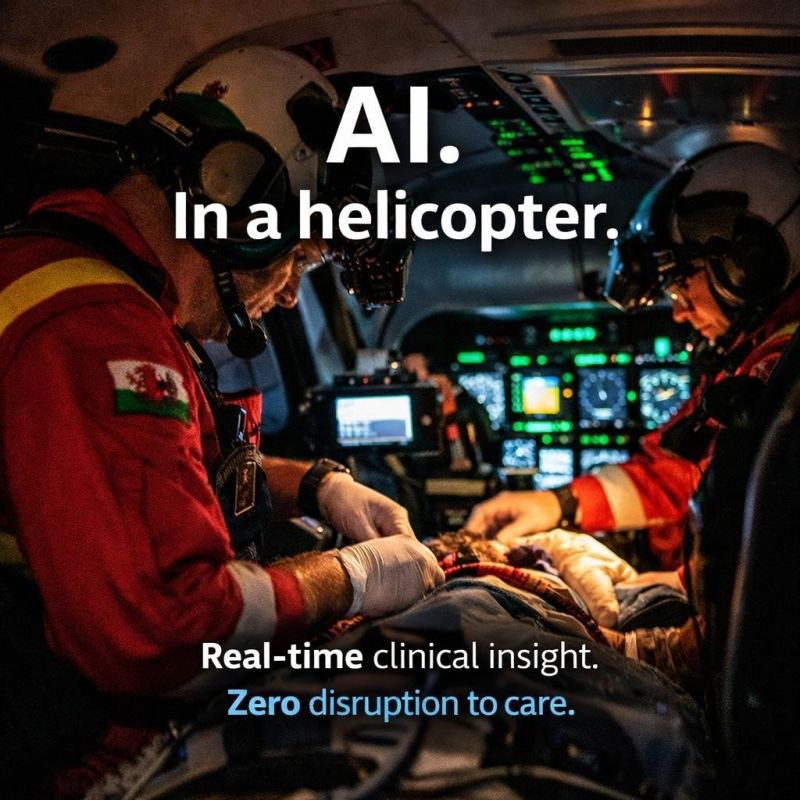
AI in a helicopter.
Real-time clinical insight. Zero disruption to care.
What happens when you bring AI into one of the most extreme clinical environments there is? Together with EMRTS Cymru, Swansea Bay University Health Board and Microsoft, we are finding out.
“…left femur looks closed, pulses present. Right wrist deformed. Laceration to the forehead, GCS fifteen. Five of morphine IV at fourteen thirty-two…”
Deformity, right wrist
Laceration, forehead
GCS 15
The setting
The Emergency Medical Retrieval and Transfer Service brings critical care to patients across Wales and the UK, often by air. Inside the aircraft the work is fast, noisy and unpredictable, and the clinical team's hands and attention belong to the patient. Documentation still has to happen, and today it competes with care.
The pilot
Following the renewal of our contract with EMRTS, we are piloting ambient voice technology in the helicopter environment. As the team talks through the patient — injuries found, observations taken, medication given and when — the system captures what is said and drafts the matching entries in the record.
- 1Listen
Captures what the clinical team says during care, without anyone stopping to type.
- 2Understand
Recognises injuries, observations, medication and times in what was said.
- 3Draft
Pre-populates the documentation fields those details belong in.
- 4Confirm
The clinician reviews and confirms each entry. The clinical record stays theirs.
What the pilot sets out to show
- Less manual documentationReduce the burden of writing things up during and after a mission.
- Clinical insight in real timeCapture what happened as it happens, not from memory afterwards.
- Zero disruption to careSupport clinicians without taking their attention away from the patient.
Why it matters beyond the aircraft
If ambient capture works in a helicopter, it can work almost anywhere care is delivered. It is the same principle behind every PA-IQ application: take information once, where the work happens, and put it to use without adding to anyone's workload.
This is a pilot, and we will share more as it progresses.